Connected strategic planning

Strategic roadmapping software that connects strategy to delivery

Turn workshop outputs into living roadmaps. Link every initiative to evidence, decisions, dependencies, owners, budgets and capacity without rebuilding the story in slides and spreadsheets.

Your integrated AI companion can help design the roadmapping flow, explain the methodology, structure inputs and identify gaps across the connected plan.

No credit cardEU-hostedTeam collaborationEnterprise deployment options
In collaboration with IfM Engage, Part of the Institute for Manufacturing, University of Cambridge
Living strategic roadmap
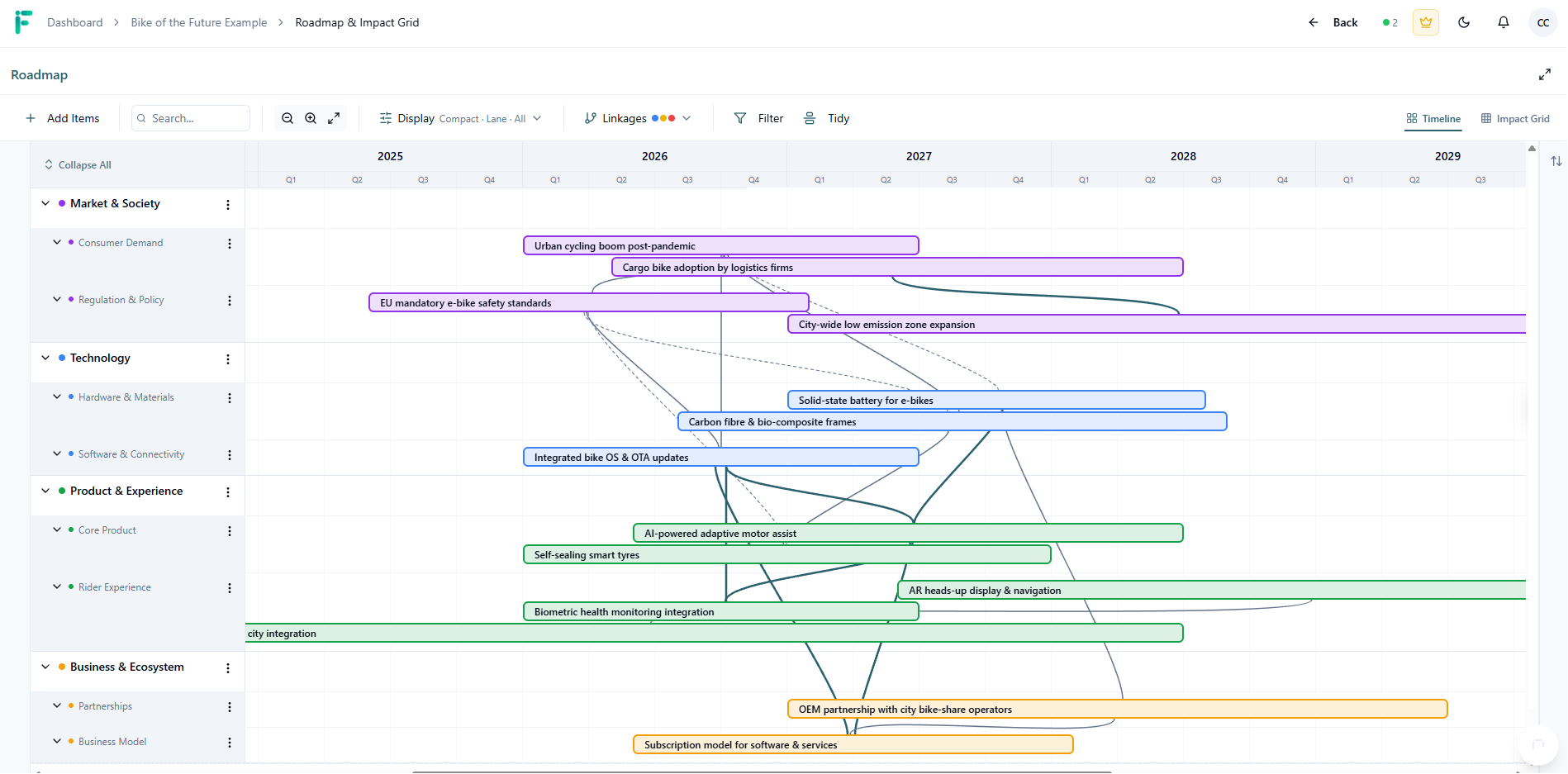
InnovationFlow roadmapping software showing a layered timeline with connected roadmap items

An AI companion for the whole roadmapping process

Move from evidence to a governed plan without re-briefing a separate chatbot.

InnovationFlow's AI Companion works across the connected workspace. It can help select and connect methods, explain the roadmapping approach, summarise inputs, identify missing links and propose structured roadmap work for facilitator review.

AI assists. Your team decides.

Read the practical guide

More than a timeline

A roadmap should explain the decision, not just display the date.

Roadmapping brings several perspectives together across time. Market change, customer needs, product or service evolution, technologies, capabilities and investments often move at different speeds. A useful roadmap makes those relationships discussable.

InnovationFlow keeps the strategic reasoning connected to the plan. Teams can move from evidence and analysis into choices, initiatives and resources without rebuilding the story in a new slide deck after every workshop.

Core capabilities

Build the roadmap and preserve the thinking behind it.

InnovationFlow supports the full roadmapping cycle, from structured inputs and workshop decisions to resource review and continued updating.

01

Layered strategic roadmaps

Organise market drivers, product or service changes, technologies, capabilities and delivery initiatives across time. Use swimlanes and hierarchy to keep different strategic perspectives visible without reducing the roadmap to a project schedule.

02

Evidence and decision lineage

Trace roadmap items back to signals, analysis, ideas and strategic choices. Change history, reasons and comments help teams understand not only what moved, but why the decision changed.

03

Dependencies and relationships

Connect enabling technologies, upstream decisions and dependent initiatives. Make sequencing logic visible so teams can distinguish a real strategic pathway from a collection of dates.

04

Resource-aware planning

Add monthly FTE and budget values, compare demand with capacity, and filter resource views by swimlane. See where the portfolio exceeds its practical limits before commitments become delivery problems.

05

Timeline and table views

Work visually on the roadmap or edit the same items in a sortable, filterable table. Different participants can use the view that best supports their task without creating separate versions of the plan.

06

Connected planning tools

Feed the roadmap from PESTLE, trends, scenarios, SWOT, TOWS, business aims, idea generation and more. Connected inputs keep the roadmap grounded in the strategic work that produced it.

Resources meet strategy

See when ambition exceeds capacity.

Roadmap items can carry monthly FTE and budget values. Stacked resource charts show portfolio demand, highlight capacity breaches and let you focus on selected swimlanes such as technologies, products or strategic programmes.

That makes resource constraints part of the strategic conversation, where they can shape sequencing and priorities, rather than a late reconciliation exercise after the roadmap has already been approved.

Roadmap timeline used to connect strategic initiatives, dependencies and resource planning

Roadmapping use cases

Five planning contexts, one connected strategic model.

Each use case starts from a different practitioner problem while preserving the evidence, relationships, resources and decisions that keep a roadmap credible.

R&D and technology roadmapping

Connect market needs, product plans, technology options, capabilities and R&D investments in one living technology roadmap.

Explore this use case

Innovation portfolio roadmapping

Connect opportunities, strategic choices, initiatives, dependencies and resources across an innovation portfolio roadmap.

Explore this use case

Resource-aware roadmapping

Compare roadmap ambition with FTE and budget capacity. Filter resource demand by swimlane and inspect own or linked initiative requirements.

Explore this use case

Sustainability and energy roadmapping

Connect policy, market needs, technology, capability and implementation choices in sustainability and energy roadmaps.

Explore this use case

Roadmap governance and implementation

Keep roadmaps current with ownership, status, review triggers, decision history, dependencies and implementation visibility.

Explore this use case

Looking specifically for market-product-technology alignment? Explore technology roadmapping software.

Roadmapping methods

Different roadmaps answer different strategic questions.

Explore research-led guides to strategic roadmapping, innovation roadmapping, technology roadmapping and product roadmapping. Each guide links the terminology to academic research and published IfM methods.

Choosing a working medium

What changes when the roadmap becomes a connected system?

Whiteboards, spreadsheets and presentation slides remain useful working media. Dedicated roadmapping software becomes valuable when the organisation needs to preserve relationships, decisions and updates across repeated cycles.

Planning needInnovationFlowStatic workshop and planning files
Strategic rationaleItems remain connected to evidence, analysis and decisions.Rationale is often stored in separate notes, slides or workshop boards.
RelationshipsDependencies and enabling links are part of the roadmap data.Lines and arrows are usually visual annotations without reusable meaning.
ResourcesFTE and budget demand can be compared with portfolio capacity.Capacity is commonly managed in a separate spreadsheet or planning system.
Change over timeHistory records what changed, who changed it and the stated reason.Teams often compare files or rely on memory to reconstruct decisions.
Ways of workingThe same data supports visual roadmap and editable table views.A single format tends to suit either workshop participants or data-oriented users.

From workshop to workflow

Keep the roadmap alive after the room empties.

  1. 1. Structure

    Design the planning flow

    Choose the strategy tools and decide what evidence should flow into the roadmap.

  2. 2. Decide

    Work with the team

    Capture inputs, challenge assumptions and make the relationships between choices explicit.

  3. 3. Continue

    Review and adapt

    Update evidence, dates, dependencies and resources while retaining the history of the decision.

Research-informed practice

Learn the method, not only the interface.

InnovationFlow Learn connects roadmapping research with practitioner problems such as maintaining roadmaps, choosing physical and digital media, aligning market, product and technology layers, and integrating resources.

Frequently asked questions

Roadmapping software questions

What is roadmapping software?

Roadmapping software helps teams organise strategic intent across time and connect it to evidence, initiatives, dependencies, ownership and resources. A strong platform supports the roadmapping process as well as the visual roadmap that process produces.

Is a roadmap the same as a project plan?

No. A project plan focuses on defined work, dates and delivery control. A strategic roadmap connects why change is needed, what responses are possible, which capabilities enable them and how choices develop over time. The two can inform each other, but they answer different questions.

Can InnovationFlow support technology roadmapping?

Yes. Teams can build layered market, product, technology and capability views, connect items across layers, track dependencies and combine the roadmap with technology scouting, push and pull analysis, capability assessment and other connected tools.

Can we use the software during workshops?

Yes. InnovationFlow is designed for facilitated strategy and innovation work. Teams can collect inputs, organise evidence, make connections and build the roadmap together, then continue using the same data after the workshop.

Does it support budgets and resource capacity?

Yes. Roadmap items can carry budget and monthly FTE values. Resource charts compare cumulative demand with portfolio caps and can be filtered by selected swimlanes.

How does AI support roadmapping?

AI can help structure inputs, suggest content, identify gaps and work across connected planning tools. People remain responsible for accepting inputs, defining relationships and making the strategic decisions represented in the roadmap.

Build a roadmap your organisation can keep using.

Explore InnovationFlow free for 30 days, or talk to us about your roadmapping process, facilitation needs and deployment requirements.

Where is your innovation system losing momentum?

Take the free 8-minute innovation and roadmapping snapshot. Get a private personalised report and practical next steps.

Start the diagnostic