Connected opportunity intake
Move accepted items from scanning, analysis and ideation into the portfolio without recreating their rationale.
Innovation portfolio strategy
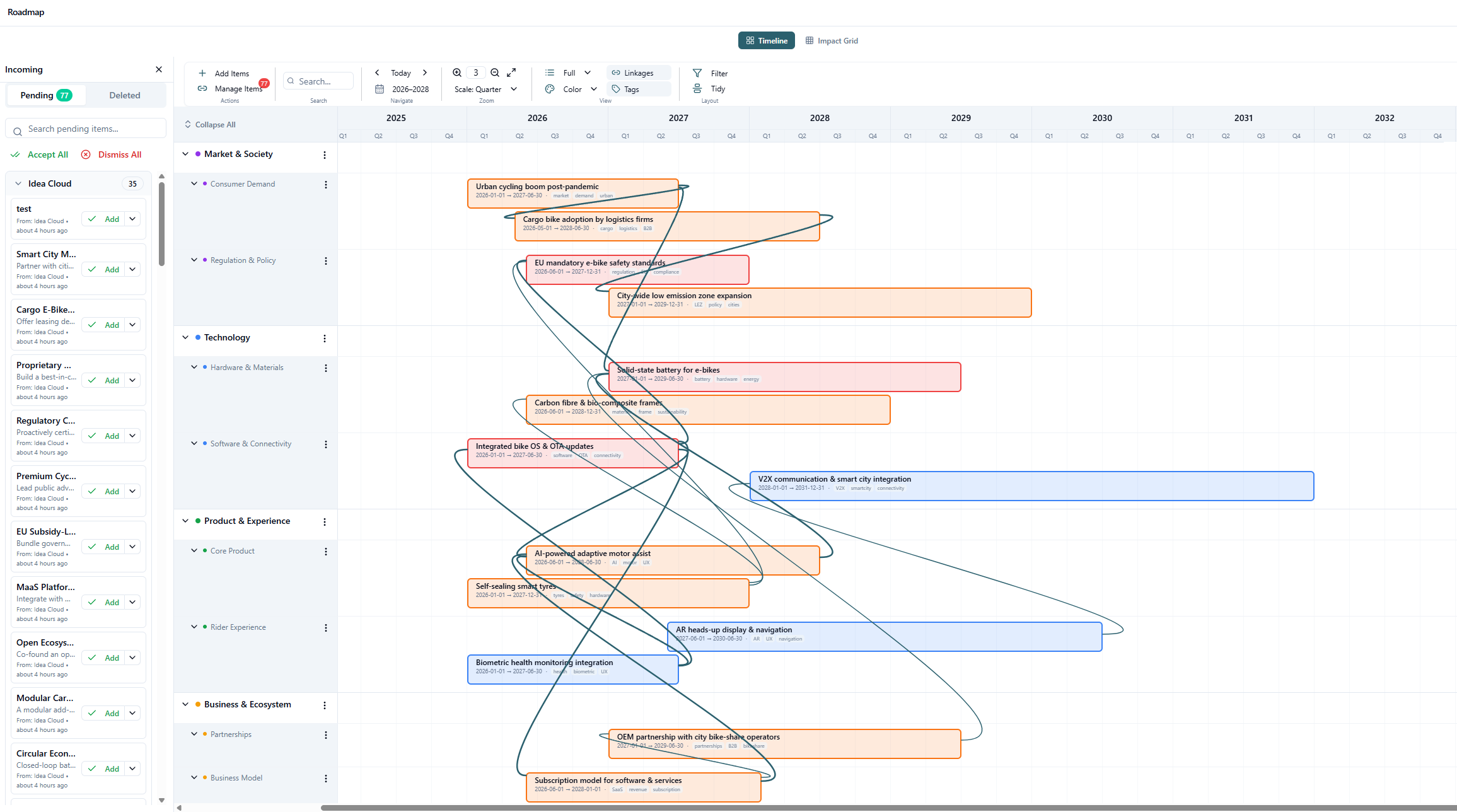
Move beyond the idea list by showing how initiatives support strategic aims, compete for resources and combine into credible pathways over time.
Designed for
The practitioner problem
Innovation portfolios often accumulate proposals faster than organisations can evaluate or deliver them. Ideas enter through workshops, scouting, customer conversations and executive requests, but their strategic rationale and dependencies can become separated from the portfolio record.
A portfolio roadmap adds time and relationships to prioritisation. It shows which initiatives create options, which depend on common capabilities, when evidence is needed and where several attractive choices compete for the same people or budget.
This is especially useful when the portfolio contains different horizons and levels of uncertainty. Early opportunities should not be forced into the same certainty language as committed initiatives, but both need a place in the strategic conversation.
Decision structure
The useful unit is not an isolated item. It is an item whose purpose, evidence, relationships and implications can be examined.
Which strategic aim or opportunity does each initiative serve?
What evidence supports the need, value and feasibility assumptions?
Which initiatives are alternatives, complements or dependencies?
What balance do we want across horizons, business areas and risk levels?
Where do several initiatives rely on the same scarce capability?
What should be explored, accelerated, paused, partnered or stopped?
Working cycle
Bring opportunities and proposals into a common intake while preserving where they came from and who contributed them.
Connect initiatives to strategic aims, customer evidence, capabilities, technologies and portfolio themes.
Use timing, dependencies, uncertainty and resource demand to reveal trade-offs that a score alone cannot show.
Capture status, ownership, reasons and changes so the portfolio remains accountable as evidence develops.
Worked structure
A service organisation is considering efficiency improvements, digital offers and a new ecosystem model. The portfolio roadmap could connect:
This is an invented example. It shows how different horizons can share evidence and capabilities without being treated as equally committed.
What the software should preserve
Move accepted items from scanning, analysis and ideation into the portfolio without recreating their rationale.
Use visual roadmaps for strategic discussion and editable tables for filtering, sorting and review preparation.
Distinguish proposed, active, blocked and completed work while retaining the reason for material changes.
Inspect an initiative on its own or include the unique resources required by connected upstream work.
Research and practice basis
These sources support the roadmapping method and practitioner problem. They are not evidence that software alone produces successful outcomes.
Roadmapping is useful as a structured strategic lens because it connects intent across time and organisational perspectives rather than treating the roadmap as a standalone chart. [1]
Research on roadmapping systems argues that organisations should design a coherent set of roadmap processes, architectures and supporting tools for their particular strategic purpose. [2]
ISO 56001 places innovation activities within a managed system, reinforcing the need to connect choices, responsibilities and evaluation rather than treating ideas as isolated records. [3]
Continue exploring
Examine the difference between collecting ideas and managing an innovation system.
Open resourceConnect signals and opportunities to capability, portfolio and commitment decisions.
Open resourceConnect portfolio choices to ownership, review and change governance.
Open resourceFrequently asked questions
No. Idea intake remains useful. Portfolio roadmapping connects selected opportunities to strategic aims, timing, dependencies, evidence, ownership and resources so they can be evaluated as part of a system.
Yes, provided their status, uncertainty and decision gates remain visible. A speculative option should not appear as committed simply because it shares the same timeline.
It complements scoring by exposing timing, common dependencies, strategic pathways and resource conflicts. Those relationships often change which portfolio combination is credible.
Explore InnovationFlow free for 30 days, or discuss the structure, facilitation and governance of your roadmapping process with a practitioner.