1
Why
Market and business drivers
Capture customer needs, policy changes, competitive pressure, strategic aims and other reasons the organisation may need to act.
From opportunity to capability
Align market and product needs with technology options, capabilities, dependencies and resources. Keep the evidence and reasoning behind the roadmap available as the plan changes.
Designed for technology-intensive organisations, innovation teams, R&D leaders, strategists and roadmapping facilitators.
The planning problem
A technology list is not yet a technology strategy. Decision-makers need to understand which market or business needs matter, what products or systems should respond, how technologies enable that response, and whether the organisation can develop or acquire the required capabilities in time.
Technology roadmapping makes those relationships visible across a time horizon. InnovationFlow turns the roadmap into a connected planning model, so evidence, choices, dependencies, resources and change history do not disappear into separate workshop files.
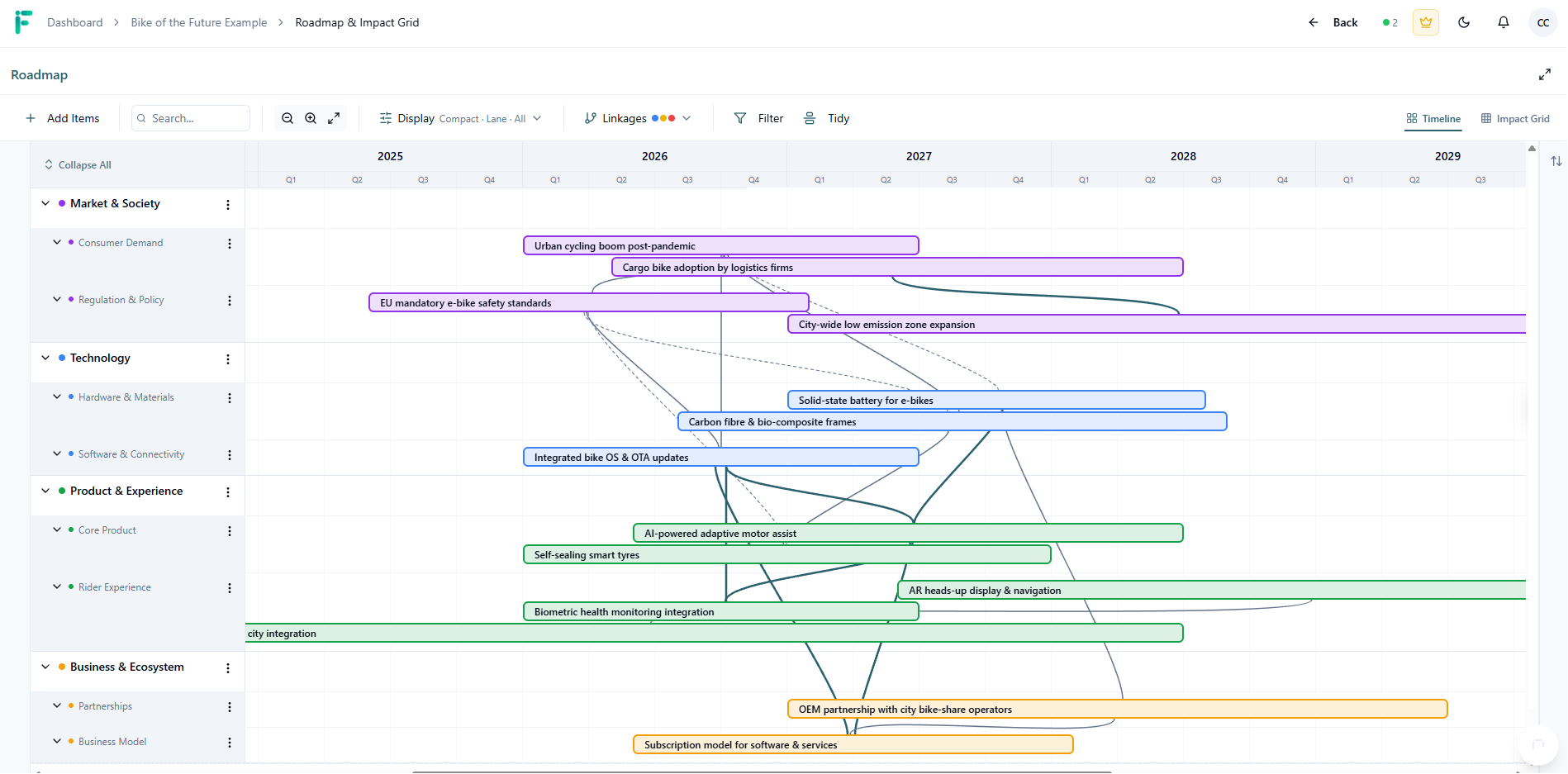
A layered roadmap architecture
The market-product-technology structure is a widely used starting point, not a rigid template. InnovationFlow lets teams adapt layers and sublayers to the management question while preserving the relationships between them.
Why
Capture customer needs, policy changes, competitive pressure, strategic aims and other reasons the organisation may need to act.
What
Describe the value propositions, system changes, product generations and service capabilities that respond to those drivers.
How
Connect the enabling technologies, organisational capabilities, partnerships and acquisition choices required to deliver the response.
Can we
Test sequencing against dependencies, monthly FTE demand and available budget before the roadmap becomes a commitment.
Research basis: Phaal, Farrukh and Probert describe roadmapping as a flexible approach for exploring and communicating relationships between markets, products and technologies over time. Their work also stresses that the simple visual format can conceal a demanding social and organisational process.
Connected technology management
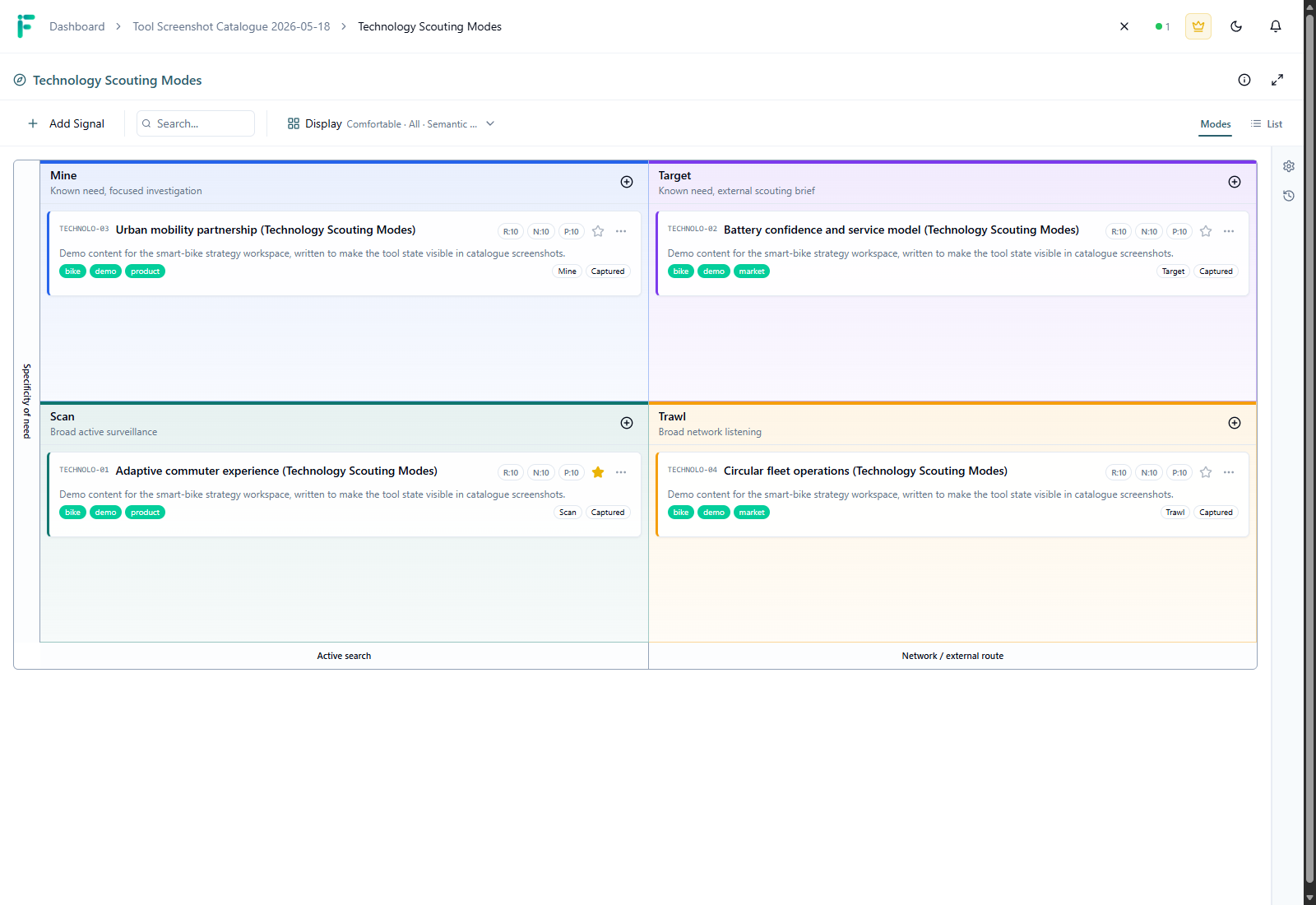
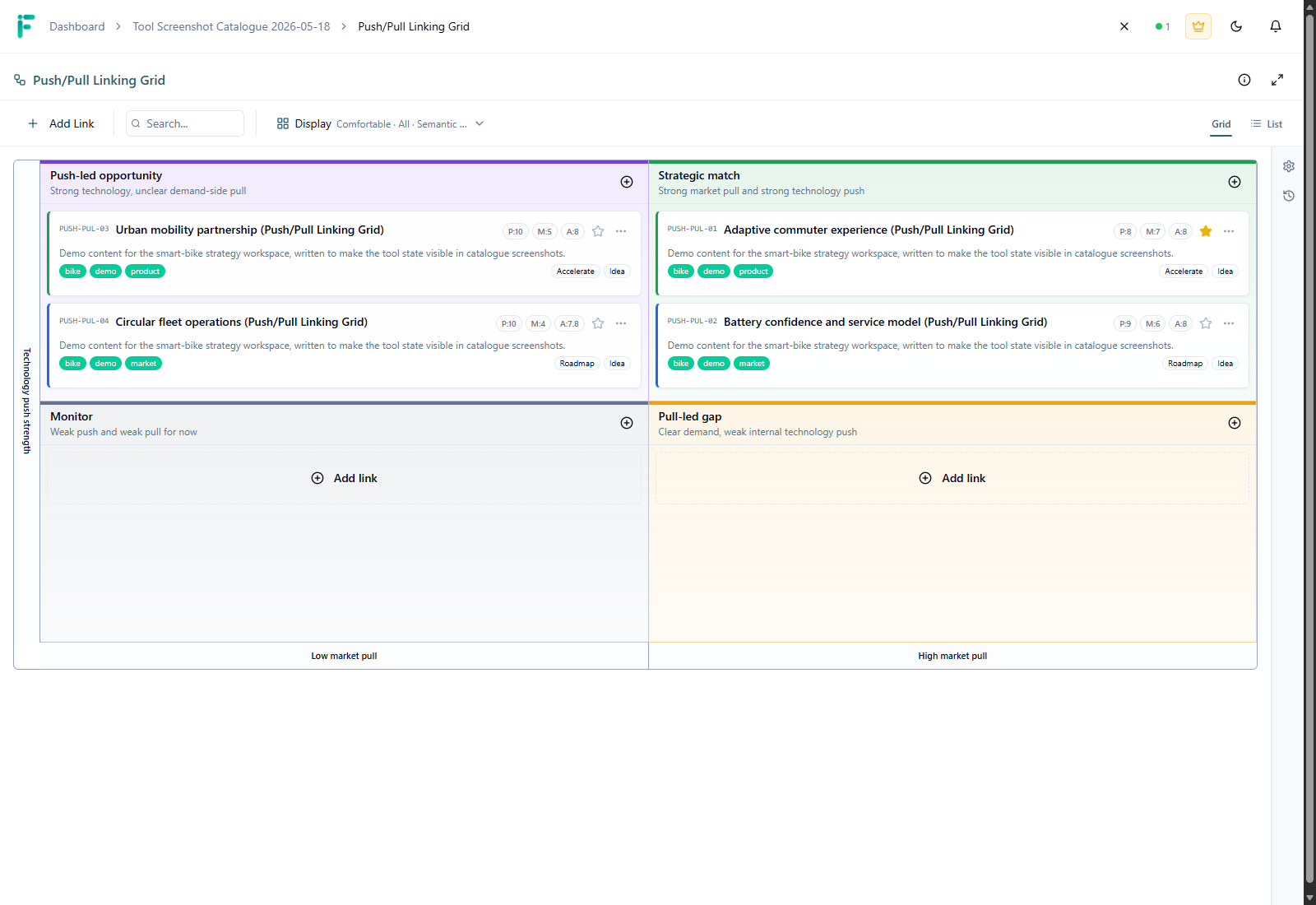
Technology strategy rarely starts on the timeline. Teams need to scan, evaluate, compare and select before they can sequence. InnovationFlow connects those activities so accepted evidence and outputs can flow into the roadmap.
From workshop to governance
Software should help a team move through the reasoning process and maintain its result. It should not encourage people to jump straight to dates.
Agree the topic, planning horizon, boundaries, participants and decisions the roadmap must support. A useful roadmap starts with a management question, not a blank timeline.
Use scanning, PESTLE, trends, scenarios, customer evidence, capability analysis and technology scouting to form an explicit evidence base.
Choose layers and sublayers that match the problem. Link drivers to products, technologies, capabilities and enabling actions across time.
Review assumptions, dependencies, gaps, technology maturity, make-buy-partner choices and alternative pathways with the people who own the decisions.
Add resource demand and capacity. Move initiatives when the combined portfolio exceeds FTE or budget limits, and keep the trade-off visible.
Assign ownership, record reasons for changes and review the roadmap when evidence, priorities or constraints change. Preserve its history instead of overwriting it.
Resource-aware roadmapping
A roadmap can be strategically coherent and still be impossible to deliver. InnovationFlow adds monthly FTE and budget values to roadmap items, then compares combined demand with available capacity.
Learn about resource-aware roadmappingSoftware evaluation guide
A polished timeline can still leave the organisation with the same fragmented planning process. Evaluate what the system preserves and connects.
Can the roadmap represent the market, product, technology and capability structure your decision needs, rather than forcing a generic project template?
Are dependencies and enabling links stored as data, or are they only lines drawn on a canvas?
Can a reviewer move from a roadmap item back to its evidence, analysis, decision, owner and change history?
Can teams compare resource demand with FTE and budget constraints across selected roadmap layers?
Can the same environment support collaborative creation, later editing, review and governance?
Can visual thinkers and table-oriented users work with the same underlying roadmap data?
Method and evidence
InnovationFlow's product design is informed by established roadmapping research and practitioner experience. The references below support the method described here. They do not constitute an endorsement of InnovationFlow by the authors or institutions.
Phaal, Farrukh and Probert (2004)
Technology roadmapping: a planning framework for evolution and revolution. Technological Forecasting and Social Change, 71(1-2), 5-26.
View the publicationIfM Engage roadmapping guide
An introductory guide to strategic and technology roadmaps, their applications, basic principles and role in communication.
Read the guidePhaal, Farrukh and Probert (2001)
T-Plan: the fast-start to technology roadmapping. A structured approach for initiating product-technology roadmapping.
View the IfM resourceRoadmapping for strategy and innovation
Cambridge material on the technique's use in aligning commercial and technical strategy and supporting strategic communication.
Explore the resourceFrequently asked questions
Technology roadmapping software supports the creation, communication and continued use of roadmaps that connect market and business needs with products, services, technologies, capabilities and resources over time. It should support the decision process as well as the final visual roadmap.
A product roadmap usually concentrates on product direction, outcomes, releases or features. A technology roadmap can connect several layers, including market drivers, product or system needs, technology options, capabilities and enabling resources. The two can be linked when product evolution depends on technology development.
Yes. Teams can define layered swimlanes, connect items across them, add time ranges and dependencies, and combine the roadmap with technology scouting, push and pull analysis, capability assessment, scenarios and other planning tools.
Yes. InnovationFlow roadmap items can include monthly FTE demand and budget. Resource charts compare combined demand with portfolio capacity and can focus on selected swimlanes or groups of initiatives.
InnovationFlow supports structured table work and import and export workflows. The important migration step is to decide which existing dates and labels should become meaningful layers, relationships, evidence and resource assumptions in the living roadmap.
Explore InnovationFlow free for 30 days, or talk to a practitioner about your roadmapping process, facilitation needs and technology strategy.