Layered roadmap architecture
Keep drivers, products, technologies, capabilities and initiatives distinct while showing the relationships between them.
R&D and technology strategy
Build a shared view of where technologies create value, when capabilities must mature and which research or acquisition choices deserve investment.
Designed for
The practitioner problem
R&D decisions connect several uncertain systems. Customer and market needs evolve, product architectures change, technologies mature at different rates and specialist capability takes time to develop. A list of projects does not explain how those elements depend on each other.
Technology roadmapping creates a structured conversation between commercial and technical perspectives. It allows teams to examine why a capability is needed, what value it could enable, which alternatives exist and when a decision becomes necessary.
The practical difficulty is continuity. Research questions, maturity assumptions and dependencies need to remain connected when the roadmap is reviewed, split across business units or translated into investment decisions.
Decision structure
The useful unit is not an isolated item. It is an item whose purpose, evidence, relationships and implications can be examined.
Which market, policy or customer changes create the need?
Which products, services or operational capabilities must respond?
Which technologies enable those responses, and how mature are they?
Should each capability be developed, acquired, partnered or monitored?
Which decisions are reversible, and which require early commitment?
Where do skills, facilities, budget or technical dependencies constrain timing?
Working cycle
Define the business scope, planning horizon, roadmap layers and participants before discussing individual projects.
Relate drivers and customer needs to product, service, capability and technology responses across time.
Compare development, acquisition and partnership routes, including dependencies, uncertainty and resource implications.
Assign ownership, record reasons and revisit assumptions when evidence, maturity or strategic priorities change.
Worked structure
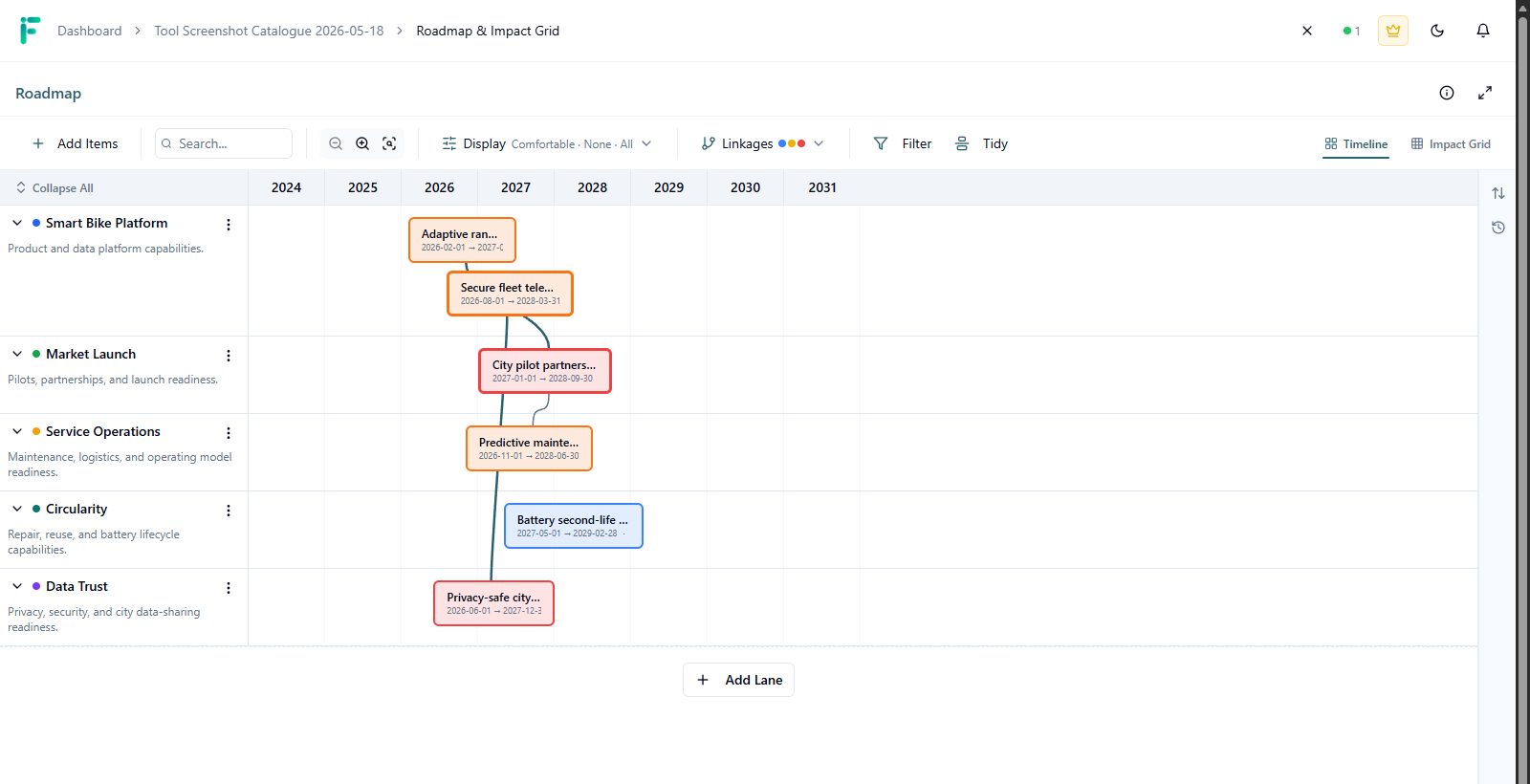
A manufacturer wants to reduce lifecycle emissions without compromising performance. The roadmap could connect:
This is an invented example. It demonstrates the structure of the decision and does not report a customer project or outcome.
What the software should preserve
Keep drivers, products, technologies, capabilities and initiatives distinct while showing the relationships between them.
Connect roadmap choices to scouting, trends, assumptions, capability assessments and strategic analysis.
Show enabling relationships and sequence decisions around technical readiness rather than arbitrary calendar dates.
Compare proposed R&D demand with people and budget capacity before the portfolio is treated as committed.
Research and practice basis
These sources support the roadmapping method and practitioner problem. They are not evidence that software alone produces successful outcomes.
Technology roadmapping research describes a flexible planning framework that can connect market, product and technology perspectives while supporting both evolutionary and disruptive change. [1]
The T-Plan approach translates that logic into a practical workshop process, with explicit attention to customisation, participation and implementation. [2]
Research in a research and technology organisation also shows why shared structures and hierarchical roadmaps become important when several organisational narratives must remain connected. [3]
Continue exploring
Explore the specialist platform capabilities for market-product-technology alignment.
Open resourceLearn how the layers create a coherent strategic narrative.
Open resourceFollow the relationships from market need to product, technology and capability choice.
Open resourceFrequently asked questions
No. A project portfolio records proposed or active work. An R&D roadmap should also connect that work to changing needs, product or service responses, enabling technologies, dependencies and strategic timing.
Yes. Options can be represented as roadmap items or connected decisions, with their evidence, timing, dependencies and resource consequences retained for review.
Use the date as the current planning assumption, then retain confidence, evidence, ownership and review triggers. The goal is a revisable decision record, not false precision.
Explore InnovationFlow free for 30 days, or discuss the structure, facilitation and governance of your roadmapping process with a practitioner.