Explicit implementation status
Use consistent status values across the visual roadmap, editable table, imports, exports and connected interfaces.
Roadmap continuity and implementation
Turn the roadmap from a workshop output into a governed strategic system with visible ownership, status, reasons for change and review routines.
Designed for
The practitioner problem
A roadmap captures a strategic view under particular assumptions. Those assumptions change as evidence develops, external conditions move and delivery work exposes new constraints. Without governance, the roadmap can become outdated while still looking authoritative.
Implementation does not mean converting every roadmap item into a detailed project task. It means establishing who owns the content, how status is interpreted, which events trigger review and how strategic changes remain connected to delivery decisions.
A governed roadmap also needs organisational memory. Future reviewers should be able to understand what changed, who changed it and why, without reconstructing the decision from several presentations and meeting notes.
Decision structure
The useful unit is not an isolated item. It is an item whose purpose, evidence, relationships and implications can be examined.
Who owns the overall roadmap and who owns each item?
What do proposed, not started, in progress, blocked and completed mean?
Which calendar reviews and external events trigger reconsideration?
What evidence or assumption justified the current decision?
Which dependencies and resource constraints affect implementation?
How are roadmap changes communicated to portfolios and delivery teams?
Working cycle
Agree roles, decision rights and status definitions before the first formal roadmap review.
Combine a proportionate calendar cadence with event-based review for material evidence and assumptions.
Capture why material changes were made and which connected items, resources or decisions they affect.
Reconcile the roadmap with implementation status and review whether completed initiatives delivered the intended capability or value.
Worked structure
A product initiative depends on a certification route that is delayed. A governed roadmap review can:
This is an invented example. It shows how status becomes useful when it is connected to evidence, dependencies and a recorded decision.
What the software should preserve
Use consistent status values across the visual roadmap, editable table, imports, exports and connected interfaces.
Retain authorship, reasons and comments for material changes rather than overwriting the earlier strategic record.
Trace affected items upstream and downstream when a driver, assumption, initiative or date changes.
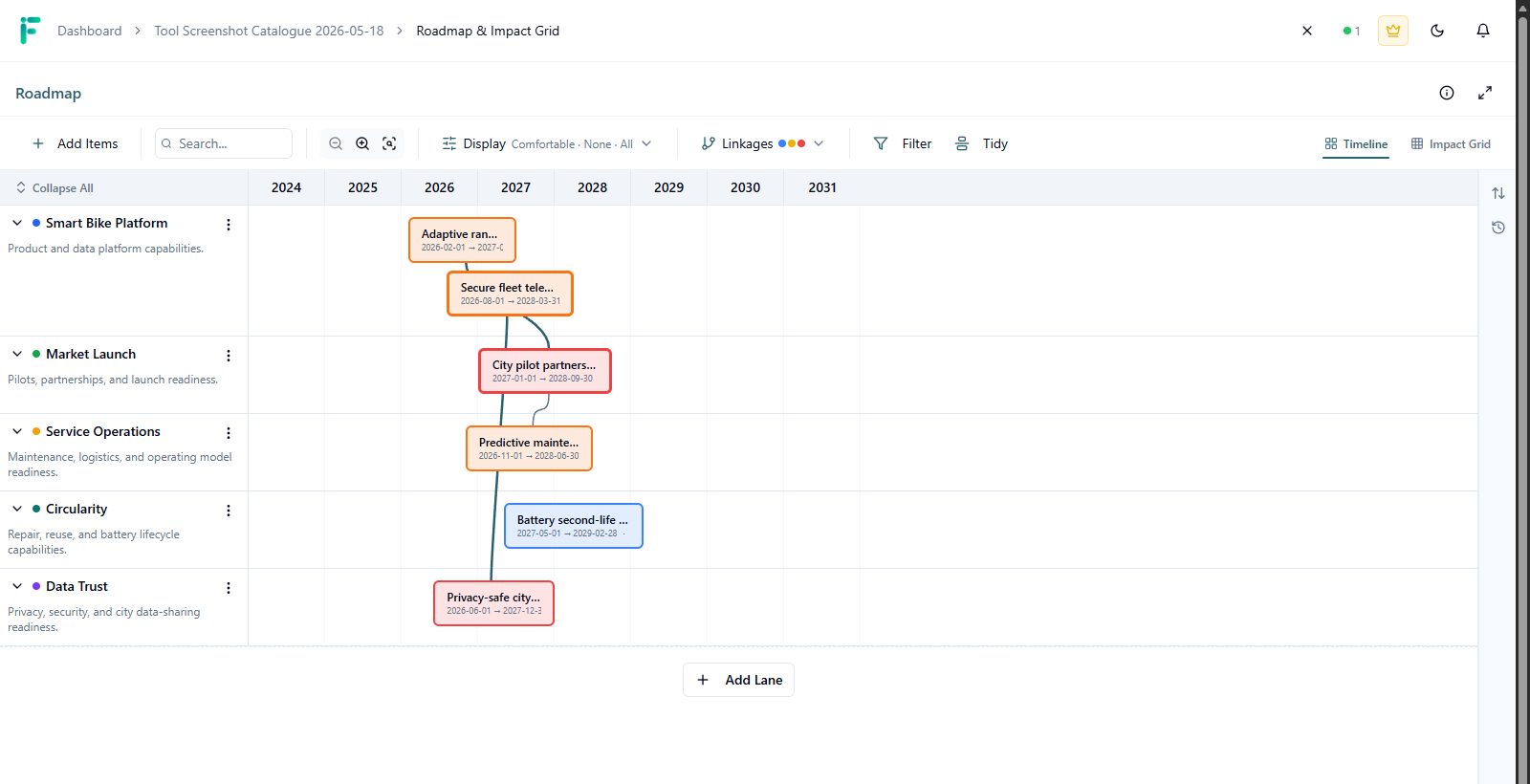
Use visual views for strategic relationships and sortable tables for status, ownership, dates and exceptions.
Research and practice basis
These sources support the roadmapping method and practitioner problem. They are not evidence that software alone produces successful outcomes.
Research on roadmap change assessment treats internal and external change as a continuing management problem, not an exceptional event after the roadmap is complete. [1]
A published account of sustaining organisational roadmapping highlights lessons from continued implementation rather than treating the initial roadmap as the finish line. [2]
Empirical research on roadmap utilisation associates appropriate software with sustained use, while also stressing process, organisational support and alignment with company objectives. [3]
Continue exploring
Review the governance principles behind ownership, cadence and change triggers.
Open resourceConnect strategic intent, architecture, participation and governance.
Open resourceChoose media for participation, capture, reuse and continuing governance.
Open resourceFrequently asked questions
A practical core set is proposed, not started, in progress, blocked and completed. Organisations should define what each means and avoid using status as a substitute for strategic review.
The cadence should reflect the rate and consequence of change. Combine regular reviews with event triggers for material assumptions, evidence, dependencies and resource conditions.
Not if the distinction remains clear. The roadmap retains strategic intent, relationships and horizons, while implementation status provides enough feedback to keep that strategic view credible.
Explore InnovationFlow free for 30 days, or discuss the structure, facilitation and governance of your roadmapping process with a practitioner.