Practice note · Roadmapping misperceptions · practitioner series
11 roadmapping myths and what practitioners should do instead
A practitioner-led series correcting 11 common roadmapping misconceptions, from confusing roadmaps with project plans to treating roadmapping as a one-time document exercise.
A practitioner series grounded in research and delivery
This series was developed by Dr Clemens Chaskel, Industrial Associate with IfM Engage. IfM Engage is part of the Institute for Manufacturing in the Department of Engineering at the University of Cambridge. It draws on Dr Chaskel's 15+ years of roadmapping experience and nearly 30 years of roadmapping research and consultancy practice at IfM.
The misconceptions matter because they shape how organisations commission, facilitate and judge roadmapping. If the method is mistaken for a project schedule or a final document, participants may never design the cross-functional process, evidence structure and review system that make roadmapping strategically useful. [1][2]
Each correction below retains the original point from the practitioner series and adds research context, practical boundaries and an implication for organisations using roadmapping software.
Myth 1: Roadmapping is project planning
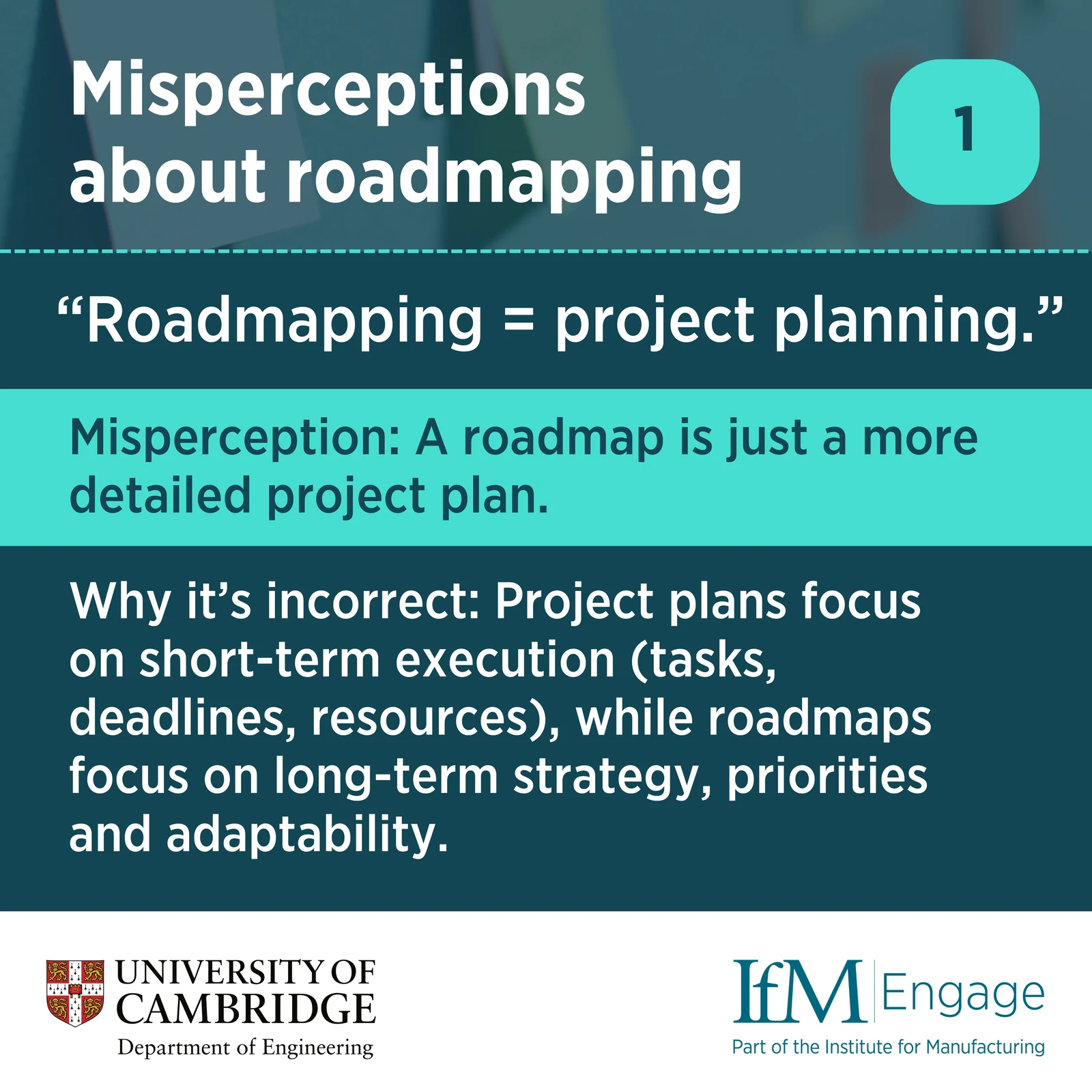
Project planning focuses on delivery detail such as tasks, dates, responsibilities and controls. Roadmapping provides a strategic, time-based structure for connecting intent, evidence, options, capabilities and action. A roadmap may inform projects, but it should not be reduced to a larger Gantt chart. [1][3]
The practical test is the question being answered. If the discussion is mainly about who completes a defined task by a fixed date, project management is appropriate. If it is about why change is needed, which pathways are credible and what must become possible over time, roadmapping adds a different strategic lens.
Myth 2: Roadmapping belongs only to R&D or technology teams
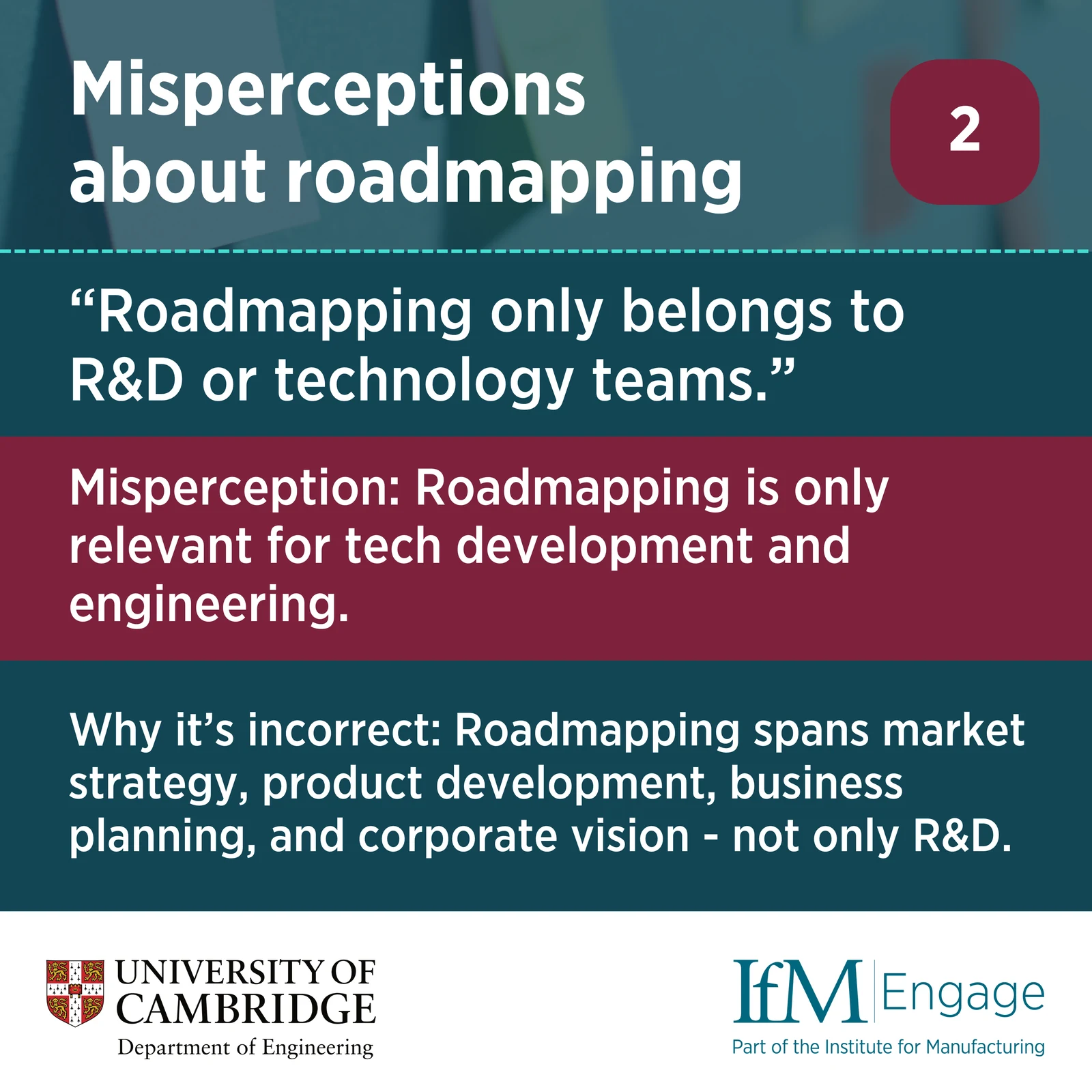
Roadmapping has strong industrial roots in technology-intensive sectors, which helps explain the association. Its architecture is much broader: layers can represent markets, customer needs, products, services, business models, operations, policy, capabilities and resources as well as technology. [2][3]
A technology-only participant group can produce a technically coherent map that lacks commercial demand, operational feasibility or organisational ownership. Cross-functional participation is not decoration. It is how the roadmap integrates knowledge that is distributed across the organisation. [4]
Myth 3: Roadmaps are static documents
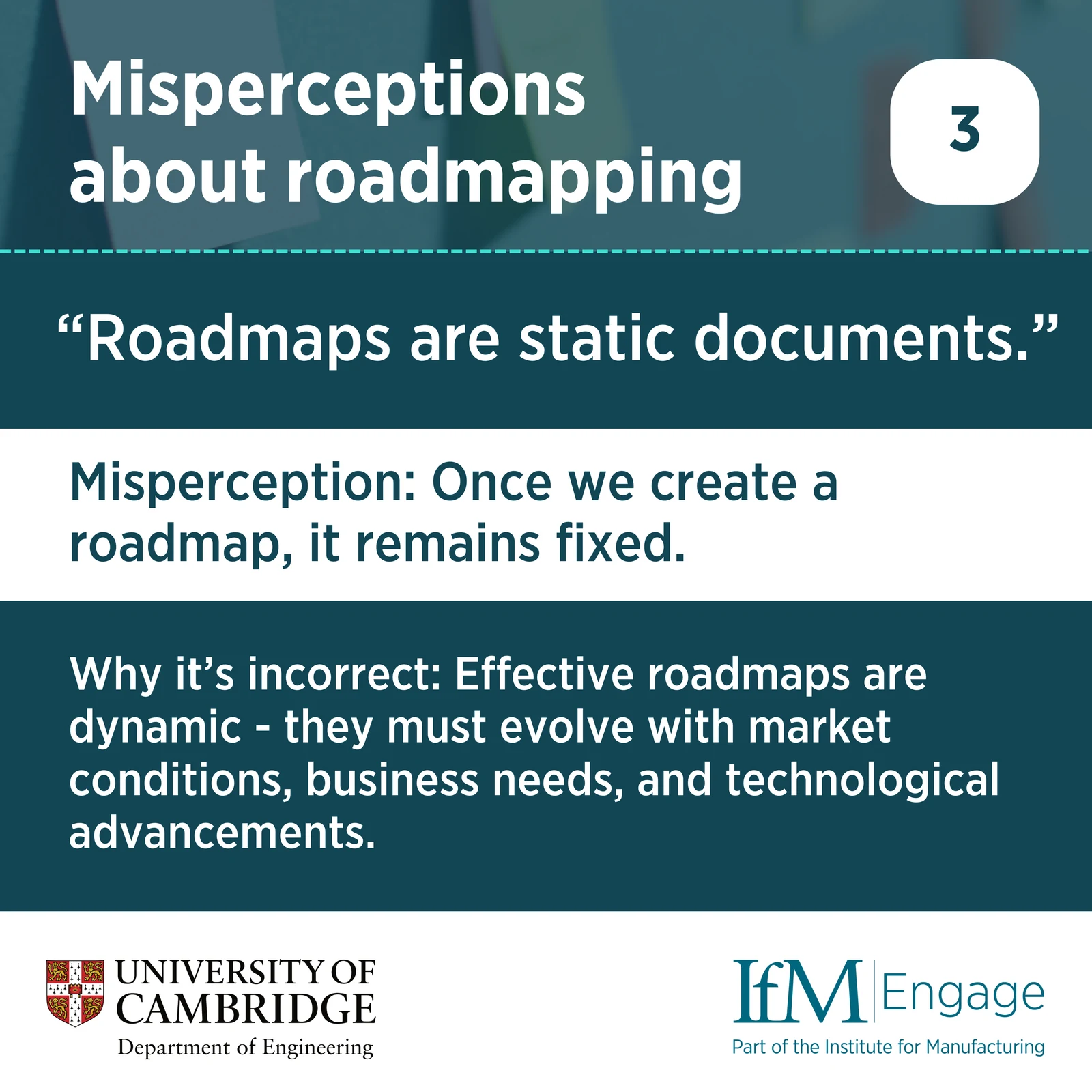
A roadmap reflects evidence, assumptions and priorities at a particular point. When markets, regulations, technologies, resources or strategy change, the organisation needs a way to judge whether the map should be retained, adjusted or reconsidered. [6]
That does not mean constant editing. A living roadmap has an owner, a review cadence and event triggers for material change. It also preserves the reason behind an update, so adaptation does not erase organisational memory. [7]
Myth 4: Roadmapping is only for large corporations
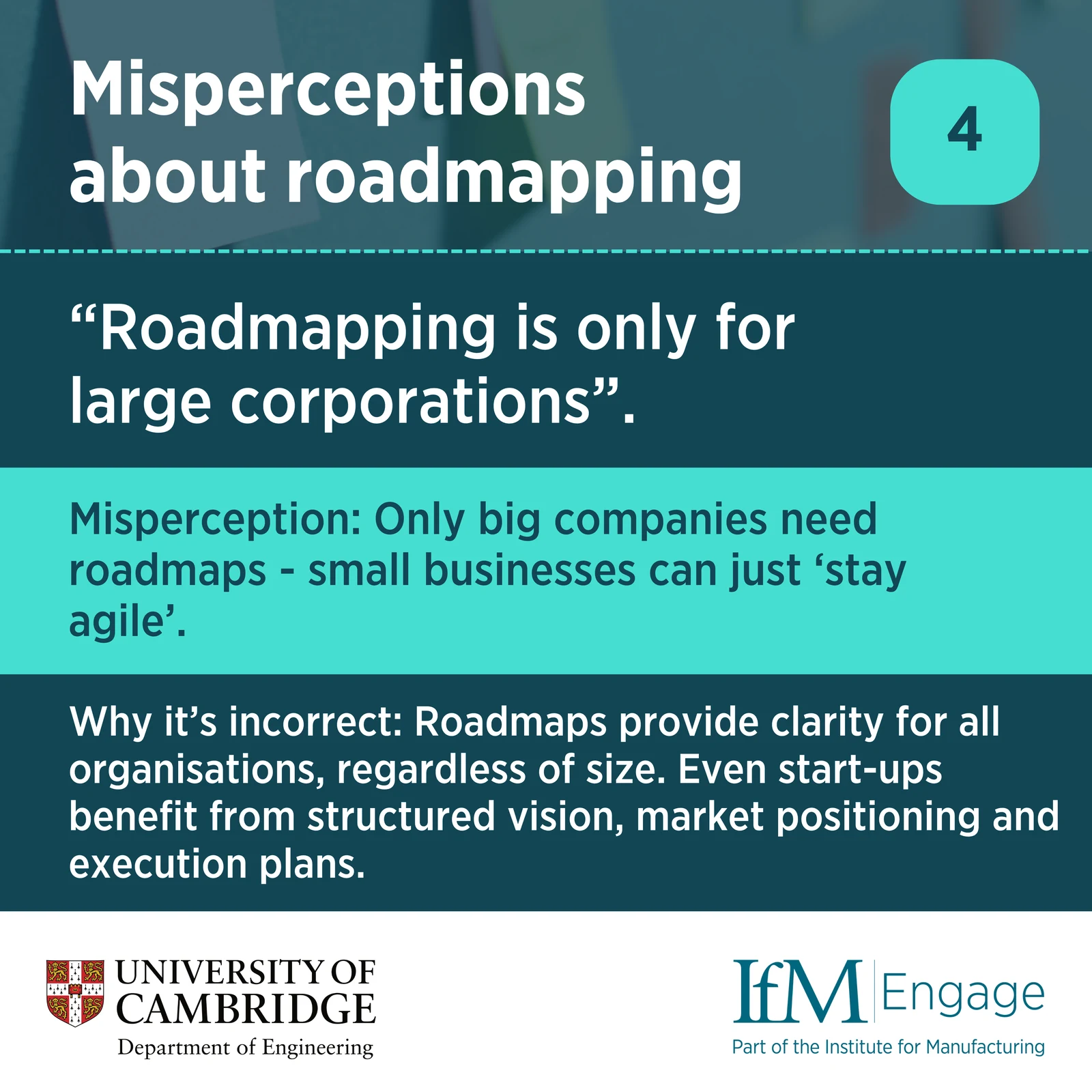
Organisation size is not part of the definition of roadmapping. The method can be scaled by changing the scope, time horizon, number of layers, participant group and level of detail. A smaller organisation may use a compact roadmap to protect focus when people and capital are especially constrained. [3]
The mistake is to copy a large corporate process into a small business. A useful design begins with the decision, participants and available effort. The roadmap should be no more complex than the strategic question requires.
Myth 5: Roadmaps must contain exact dates and deadlines
Time is fundamental to roadmapping, but precision should match the evidence and the decision. Near-term commitments may need dates. Distant options may be better represented by horizons, windows, maturity stages or event-based triggers. [1]
False precision makes uncertainty look like commitment. The better question is whether participants can see sequence, dependency and the point at which a decision becomes necessary. Detailed delivery dates can then remain in the project systems designed to manage them.
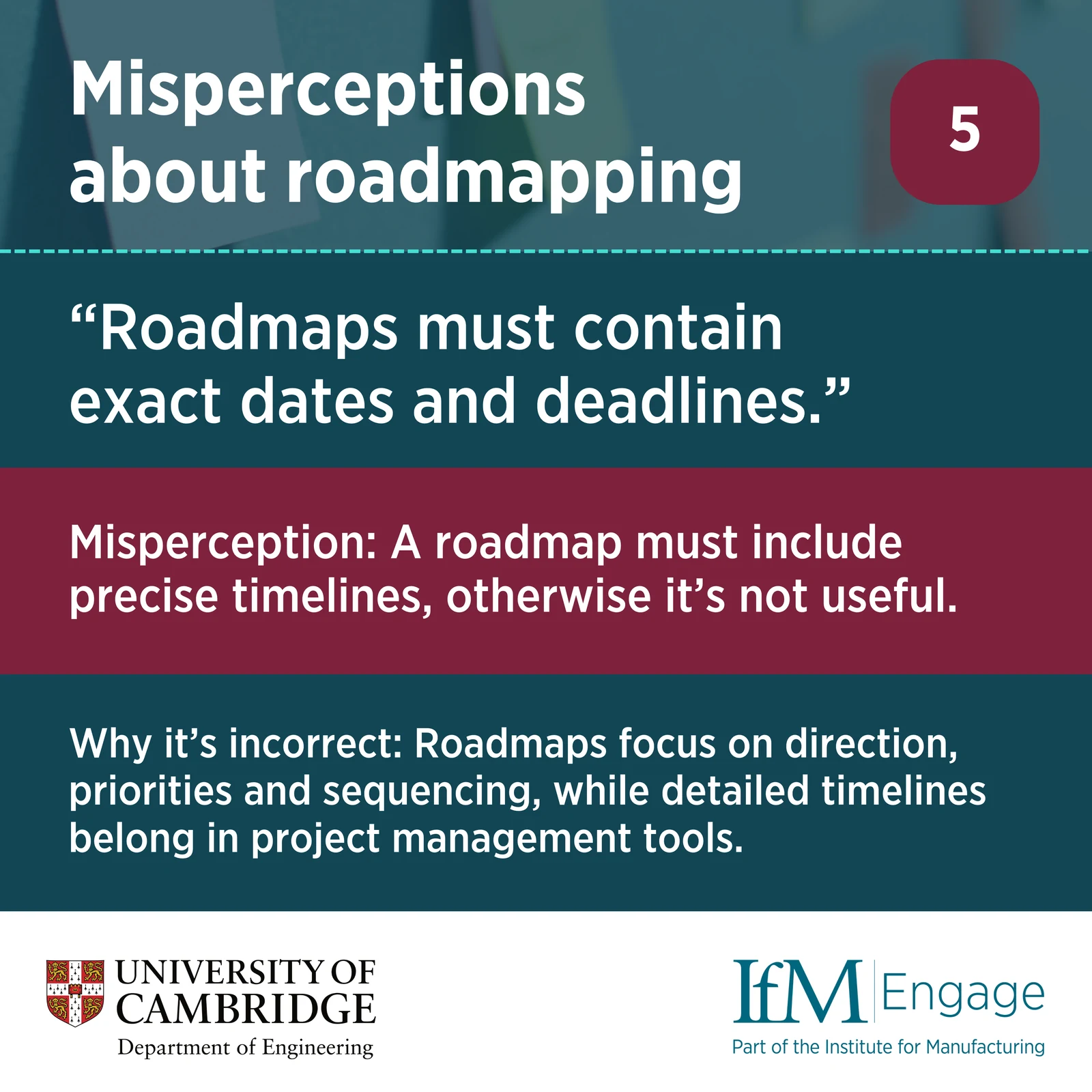
Myth 6: Roadmapping only tracks innovation and technology trends
Trends and emerging technologies can populate the evidence or capability layers of a roadmap. They are inputs, not the whole method. Roadmapping can connect external change with value, products, services, processes, organisational capabilities, investments and actions. [3]
The same flexible architecture can even be applied to a business process. Roadmapping Roadmapping uses roadmapping to design how an organisation will introduce, govern and improve its own roadmapping system. [8]
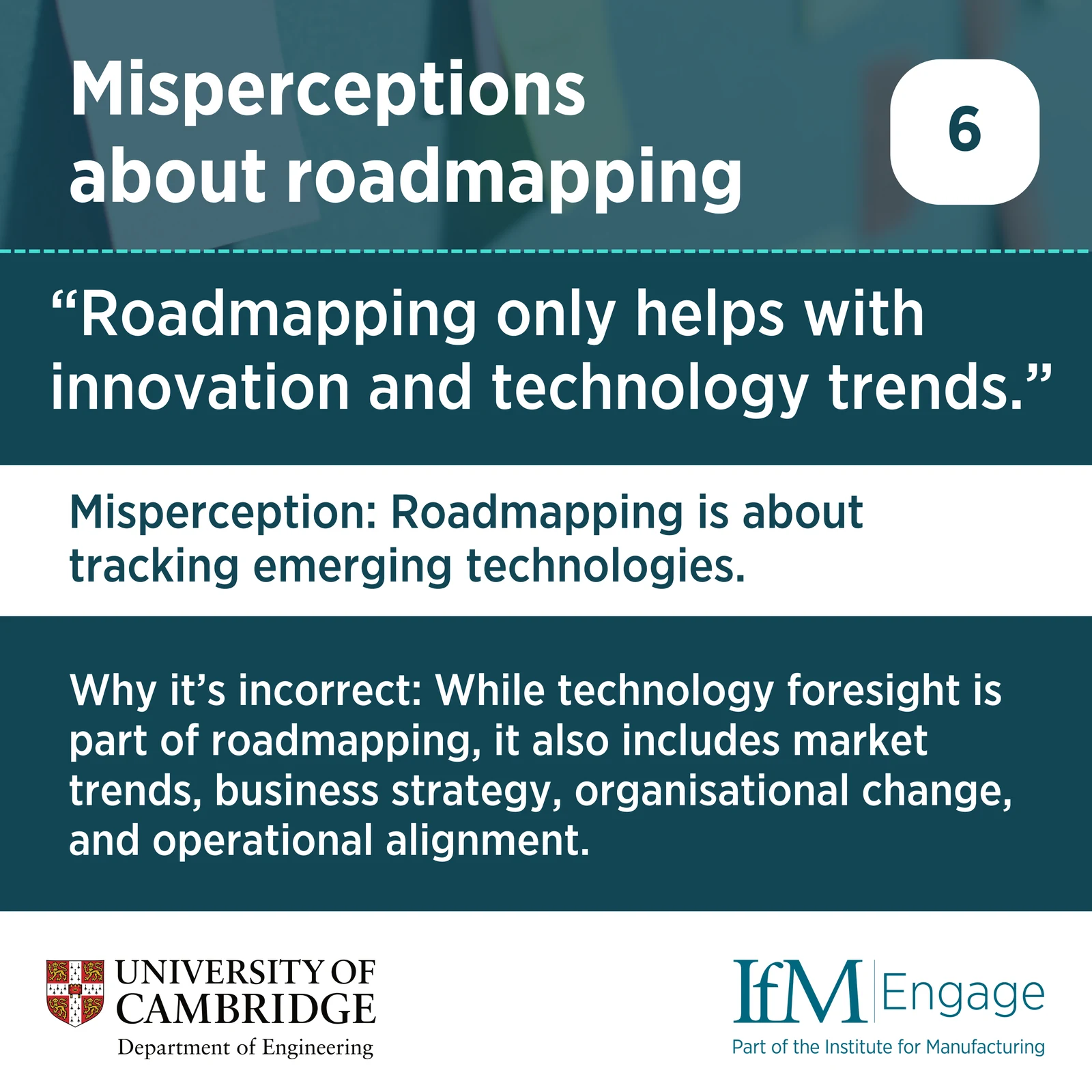
Myth 7: Roadmapping is too complex to implement
Systematic roadmapping can be difficult to deploy and sustain. The research does not support pretending otherwise. The useful correction is that complexity can be managed through clear purpose, bounded scope, structured prompts, facilitation and rapid first iterations. [8]
Fast-start processes such as T-Plan and the R2 workshop demonstrate how a structured first pass can create shared understanding and a basis for learning. The initial roadmap does not need to settle every question. It needs to expose the important ones and create an actionable next step. [5][8]
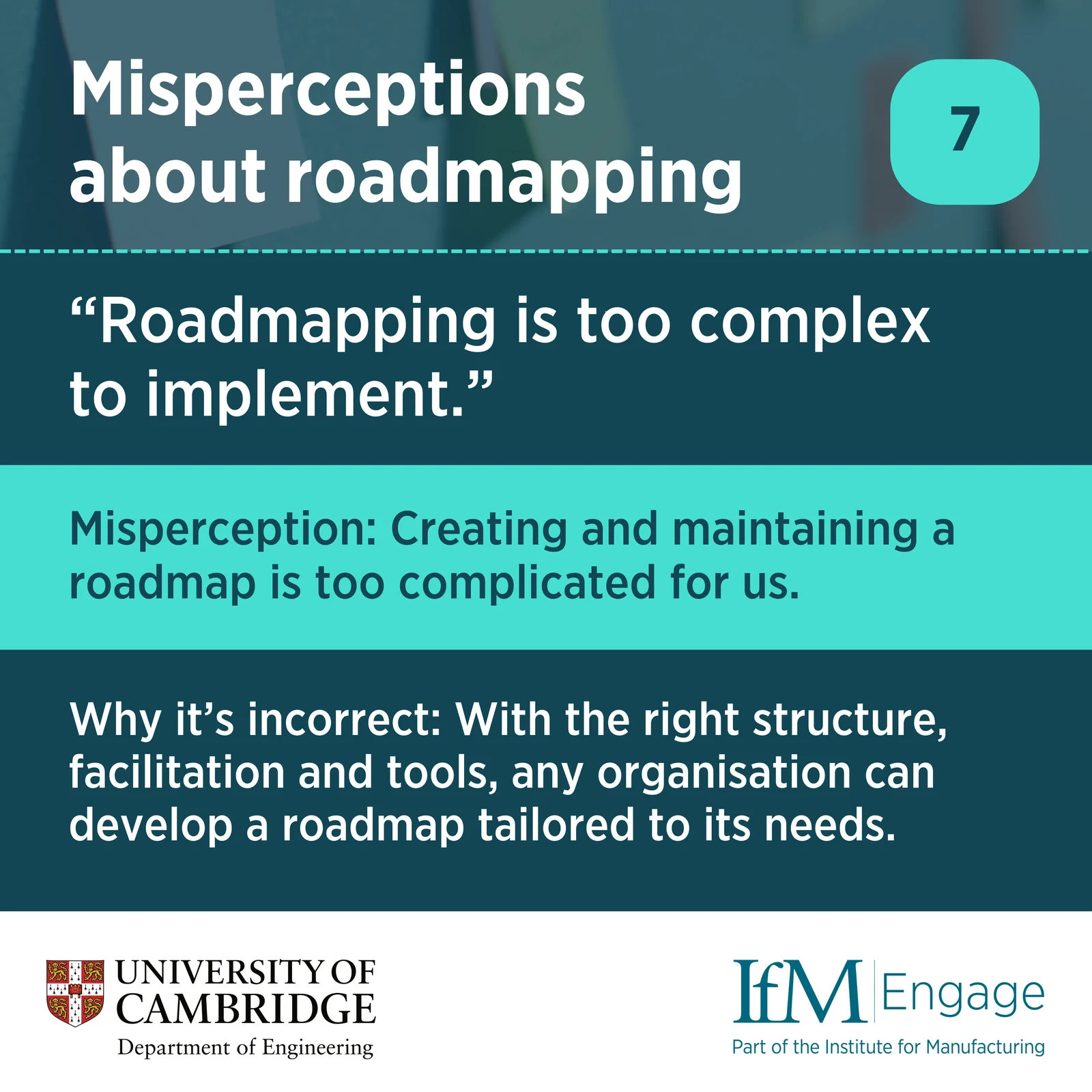
Myth 8: Roadmaps must always be highly detailed
Roadmap detail should follow purpose and audience. Senior decision makers may need the strategic narrative, critical dependencies and resource implications. Specialists may need a deeper view of one layer or capability. Both can be valid views of the same system. [3]
Excessive detail can hide the relationships that matter. A roadmap is not improved by adding every task. It is improved when participants can explain why an item exists, what it enables, what depends on it and what decision follows.
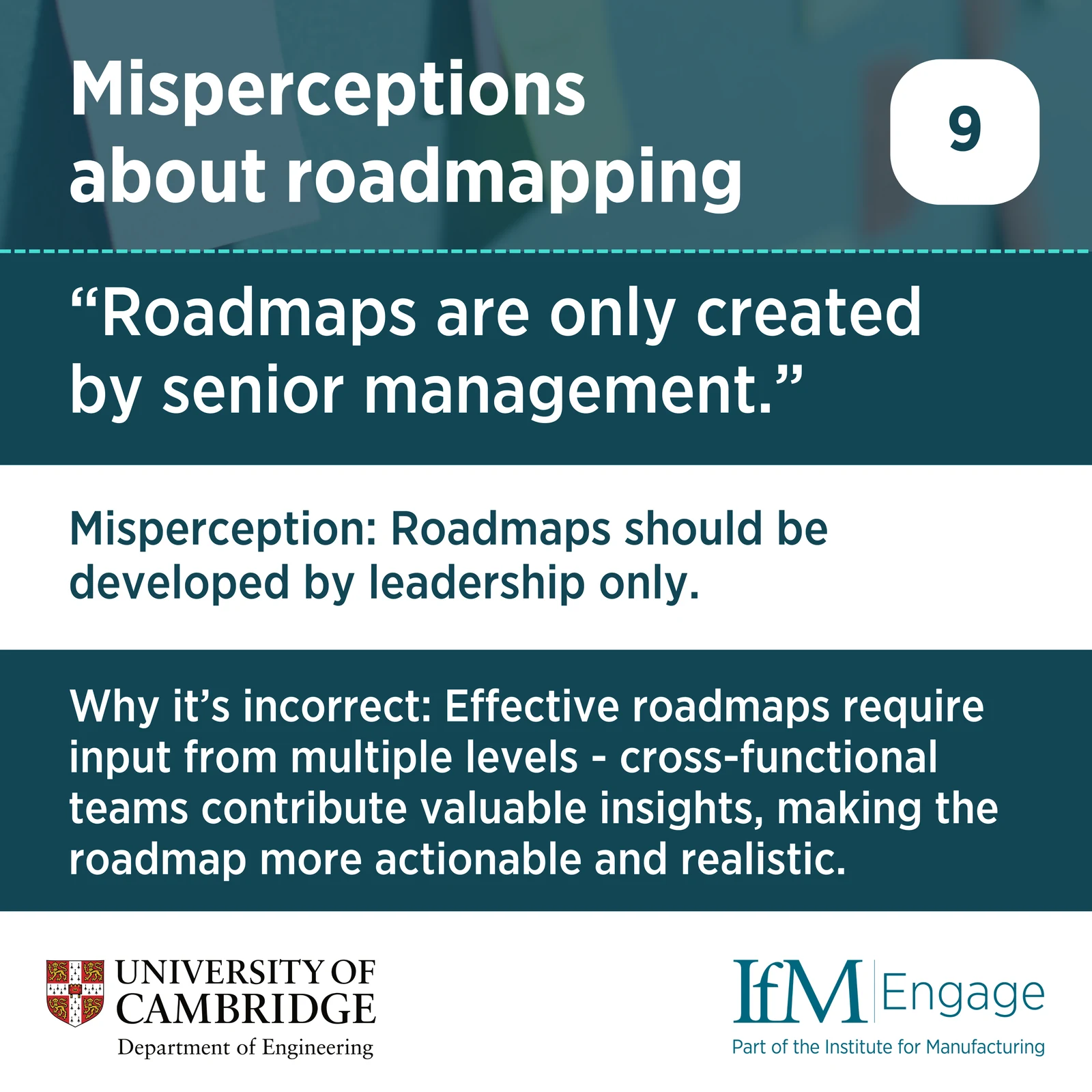
Myth 9: Roadmaps should be created only by senior management
Leadership provides purpose, sponsorship and decision authority. It does not hold all the knowledge needed to test feasibility, dependencies and implementation. Roadmapping workshops are valuable partly because they bring technical, commercial and operational perspectives into one structured conversation. [4]
Participation still needs design. Not everyone must attend every session, but the roadmap should identify whose knowledge and commitment are needed at each stage. External perspectives and minority views can also prevent consensus from becoming groupthink. [8]
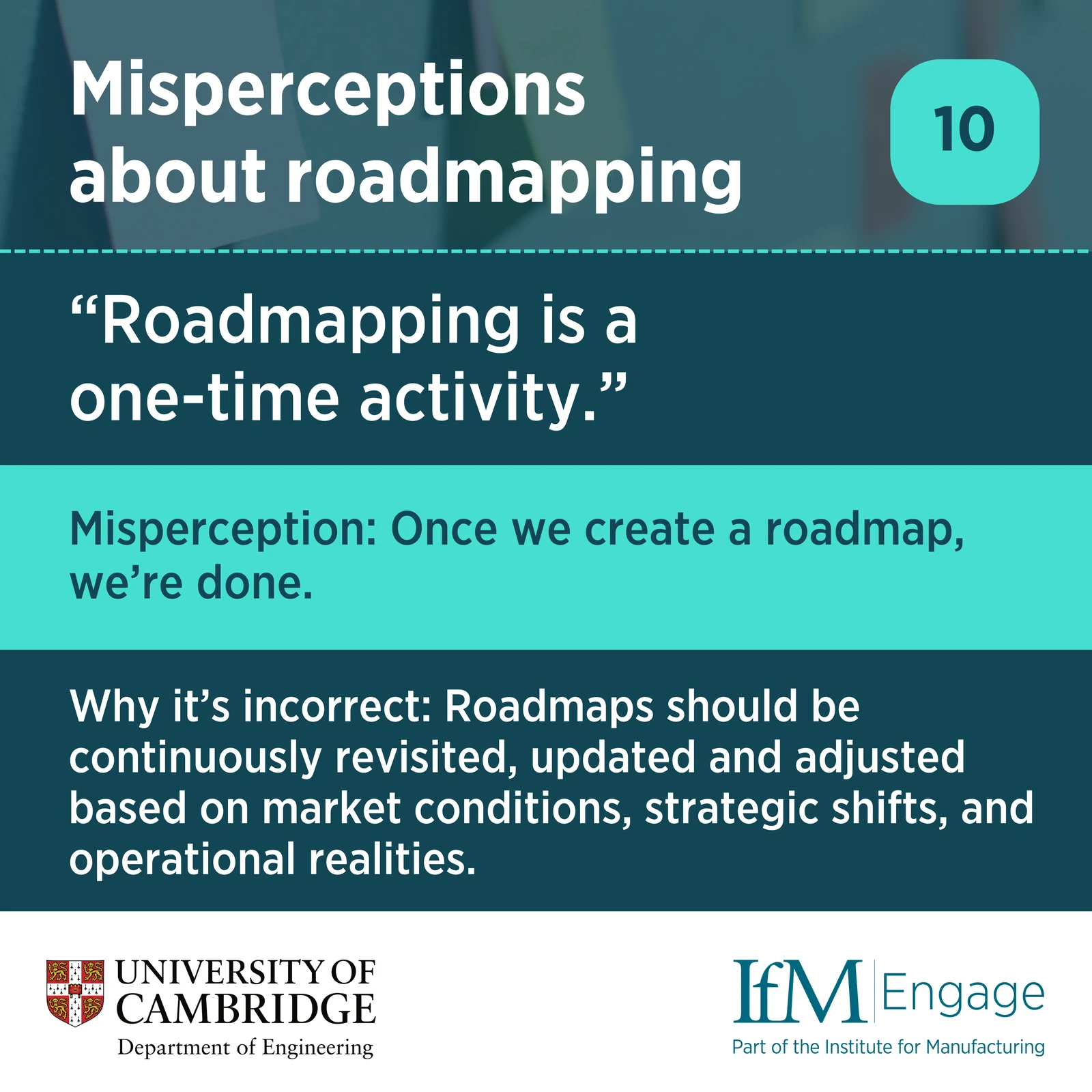
Myth 10: Roadmapping is a one-time activity
A workshop can initiate a roadmap, but implementation research treats roadmapping as an organisational process that develops over time. Ownership, capability building, integration with decisions and continued review determine whether the work remains useful. [7]
The roadmap should return to the evidence when important conditions change. That review may confirm the existing direction, adjust a pathway, stop an initiative or change the system used to maintain the roadmap. Continuing the process does not mean defending the original plan. [6]
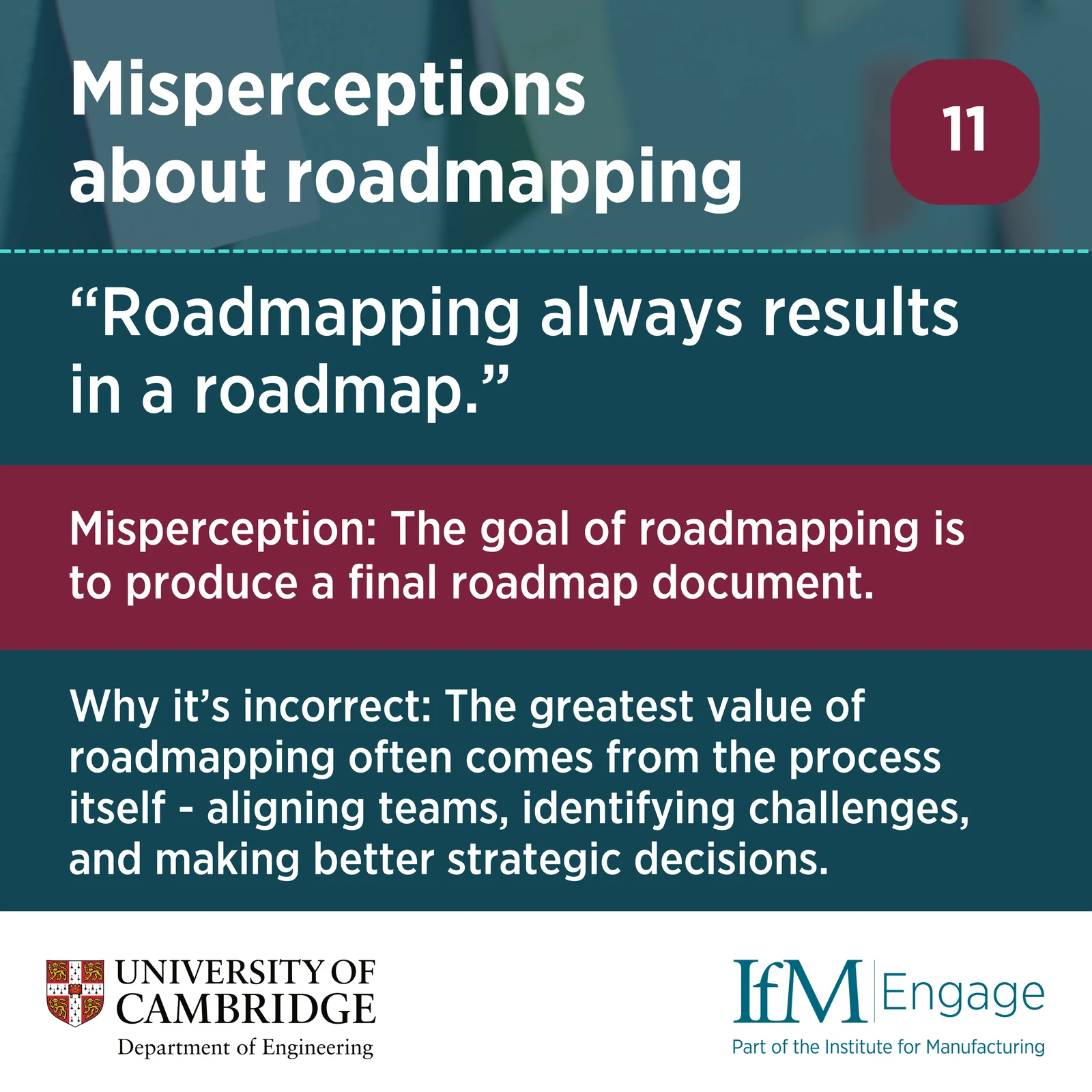
Myth 11: Roadmapping always results in a roadmap document
Roadmapping is a process; a roadmap is an artefact. Research definitions describe roadmapping as the application of a structured strategic lens across time and organisational perspectives. That process can organise knowledge, align participants and support a decision even when no polished roadmap is produced. [1]
This distinction protects the real value of the work. A visually impressive chart is not evidence that difficult assumptions were challenged. Conversely, a structured workshop that changes a strategic choice can be valuable before its outputs are turned into a communication roadmap. [8]
Turn the corrections into a working roadmapping system
Taken together, the myths point to one conclusion: useful roadmapping is a designed organisational system. It combines a strategic question, an appropriate architecture, the right participants, an explicit decision process and a way to continue after the workshop.
Software can reduce the friction of maintaining that system when it preserves relationships, evidence, ownership, resources, status and reasons for change. AI can help propose structure, extract candidate inputs, suggest connections and identify gaps, while people decide what becomes part of the organisational record. [9]
References
- [1]Kerr, C. and Phaal, R. (2021). Roadmapping and Roadmaps: Definition and Underpinning Concepts. Strategic Technology Management. Source ↗
- [2]Kerr, C. and Phaal, R. (2020). Technology roadmapping: Industrial roots, forgotten history and unknown origins. Technological Forecasting and Social Change, 155, 119967. Source ↗
- [3]Phaal, R. and Muller, G. (2009). An architectural framework for roadmapping: Towards visual strategy. Technological Forecasting and Social Change, 76(1), 39–49. Source ↗
- [4]Phaal, R., Farrukh, C.J.P. and Probert, D.R. (2007). Strategic Roadmapping: A Workshop-based Approach for Identifying and Exploring Strategic Issues and Opportunities. Engineering Management Journal, 19(1), 3–12. Source ↗
- [5]Phaal, R., Farrukh, C.J.P. and Probert, D.R. (2001). T-Plan: The fast start to Technology Roadmapping - planning your route to success. Institute for Manufacturing, University of Cambridge. Source ↗
- [6]Gerdsri, N., Puengrusme, S., Vatananan, R. and Tansurat, P. (2019). Conceptual framework to assess the impacts of changes on the status of a roadmap. Journal of Engineering and Technology Management, 52, 16–31. Source ↗
- [7]Hirose, Y., Phaal, R., Farrukh, C., Gerdsri, N. and Lee, S. (2022). Sustaining Organizational Roadmapping Implementation - Lessons Learned from Subsea 7. Research-Technology Management, 65(3), 50–57. Source ↗
- [8]Phaal, R., Chaskel, C., Gonzalez Nakazawa, R. and Ross, J. (2024). Roadmapping Roadmapping: Strategic planning for roadmapping systems. Frontiers of Engineering Management, 11(3), 516–527. Source ↗
- [9]IfM Engage, University of Cambridge (2026). Strategic planning software: InnovationFlow.app. IfM Engage product page. Source ↗